

Travel stories blog
THE ZEPPOS-0060 TRAVEL STORYby Georges De Caluwé, CptnZeppos passenger
Here you will find the blog written by Georges De Caluwé, CptnZeppos traveler.
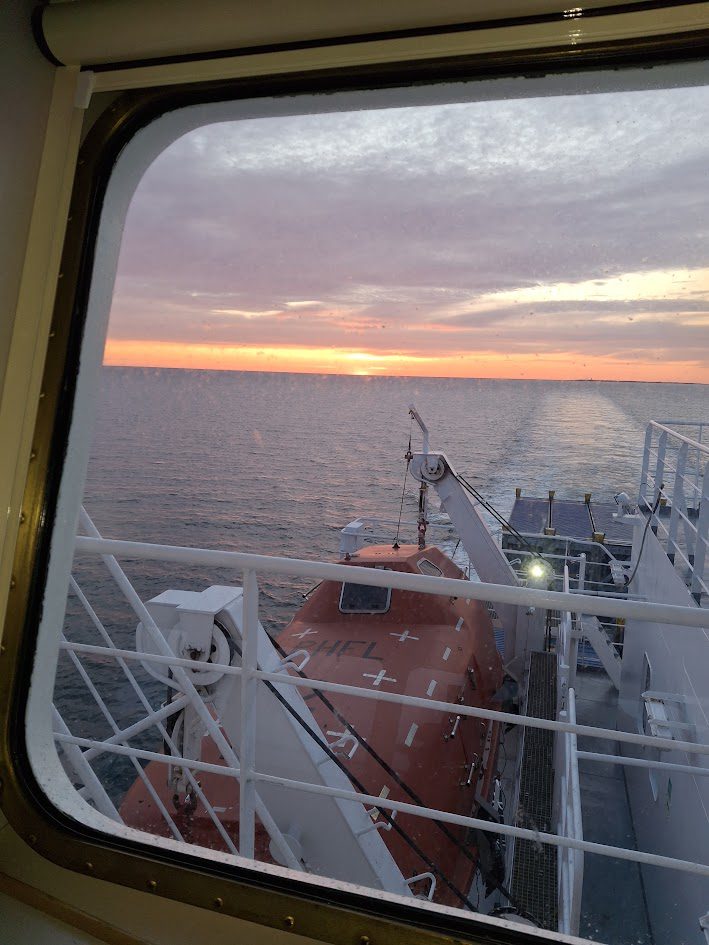
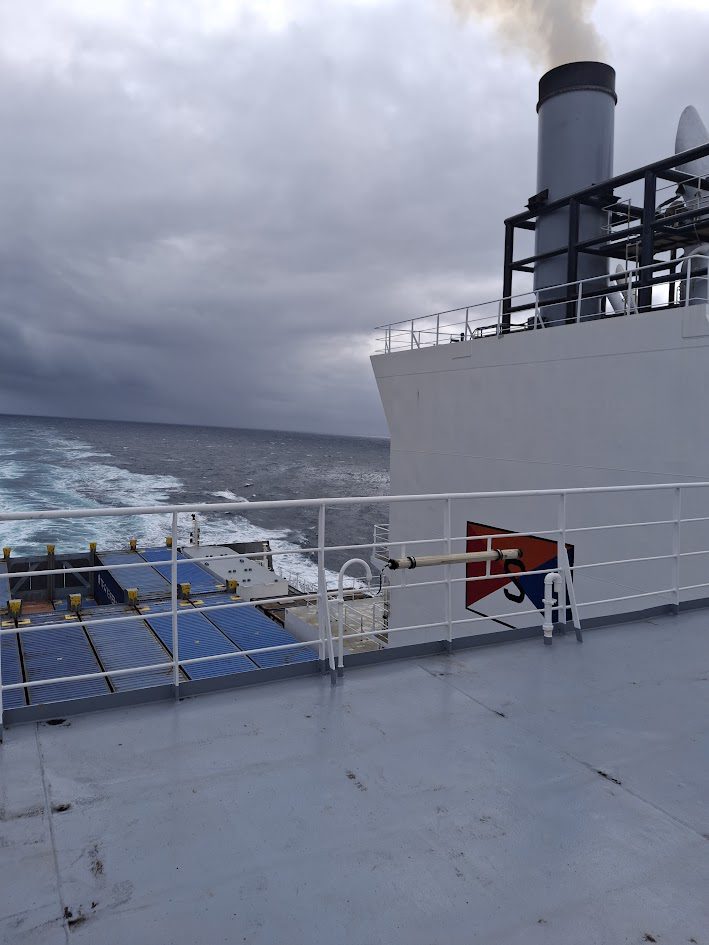
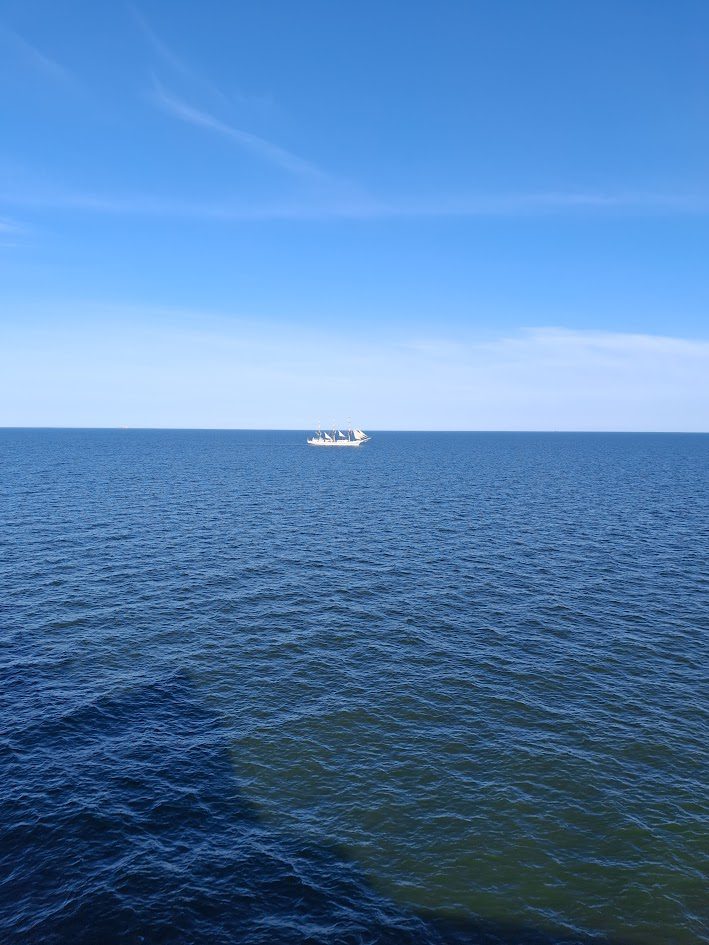
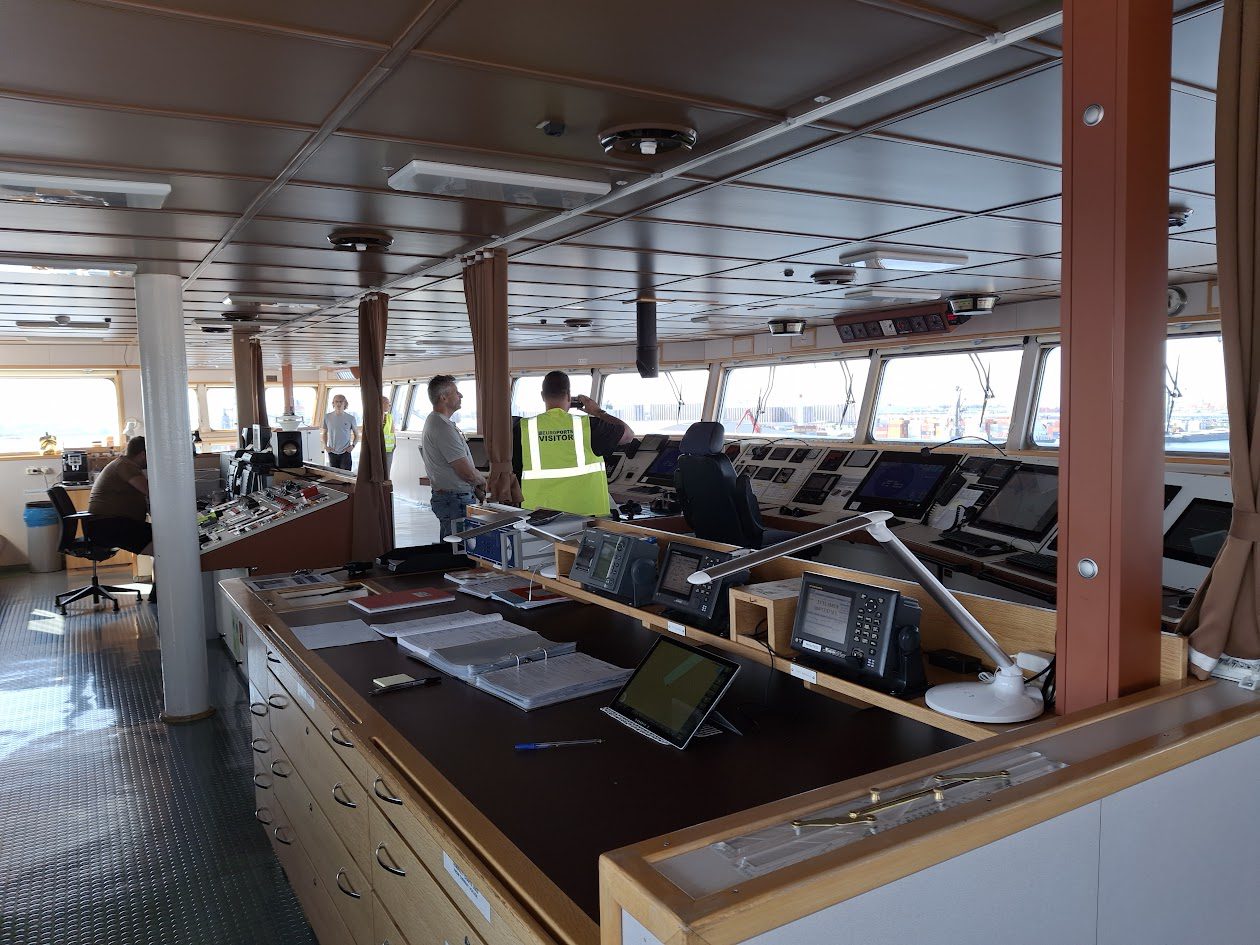
Eight days aboard the Timca. Report of a sea voyage from Antwerp to Hanlo and Rauma in Finland and back, aboard the Dutch CONRO ship TIMCA. Where polder farmers once plowed clay fields, a seagoing vessel plowed through the dock waters of Waaslandhaven for a sea voyage to the Gulf of Bothnia. Shortly before, the Timca, as the ship is called, was loaded with crates, trailers, and trucks. Even an oversized combine harvester was driven onto the loading bridge of the ro-ro ship. It will no longer harvest here in the Kallose polder, but it will in Finland, the destination of the voyage. A colossal bulldozer was also stowed away, not to bury the polder clay under five meters of sand, as had already been done half a century earlier. There was an enjoyable bustle on the quay, observed from a small platform behind the white castle of the equally white ship: reach stackers driving back and forth, which are rigs with a long and especially strong arm from which a so-called spreader dangles to lift cargo containers with ease and place them next to the harbor crane, where, high and dry, an operator in turn aims the container at its designated place on deck. Down below, trailer drivers deftly steer mobile loads across the loading bridge onto the lower deck, seated on a swivel chair that allows the driver to look in the opposite direction in the blink of an eye each time he begins a new maneuver. This spectacle of busy human ants would repeat itself several times later in the two Finnish ports, Hanko and Rauma, which the ship called at on this voyage. There were also people on board, or at least they got themselves on board, the six passengers who boarded the gaping open belly of the ConRo ship via the loading bridge, somewhat sheepishly, but full of anticipation. They were not all landlubbers; one, a pleasant man from Delft had already been on several cruises at sea and had them fresh in his memory, another, a bright West Flemish man, had even sailed offshore. The third, a tall Belgian, who had been steeped in the romance of ships from an early age, had until then only talked about seafaring as a guide on harbor tours. Now, after almost a lifetime, he would put his words into action. Two French ladies provided some counterbalance to the gender balance, not only in relation to the travel group, but also in relation to the crew which consisted exclusively of male members. Finally, a sixteen-year-old Dutch student joined the group, accompanied on board by his caring-looking mother. A big kiss and the young man was allowed to begin his maiden voyage, dreaming of seafaring ahead? All six of them shared a cabin, with the exception of the French women, who kept each other company for the entire journey during meals, on deck, and in the cabin with bunk beds. After the feverish activity on the quay had gradually died down, a sacred silence fell, which enchanted the passengers: waiting to set sail. Then the funnel spewed emitted brown smoke and the ship's hull began to vibrate in all its joints. It was easy to get used to, because it continued until the next port. The travelers eagerly awaited a boatswain to cast off the mooring ropes. A gentle swell replaced the solid ground beneath their feet. Later, on the North Sea, from the German Bight, the swell would turn into light pitching and moderate rolling, enough to give two passengers a mild form of seasickness and prompt a third to reach for the miracle pill. In the end, no one need a bucket. After one or two nights, the rumbling of the twelve-cylinder engine that propels the ship, and the incessant vibration would seem like a lullaby to those sleeping in the cabins. From then on, the fate and well-being of the passengers was partly determined by a Dutch captain with his three Russian helmsmen, three Russian engineers and fourteen Filipino sailors, including a cook and a cook's assistant, who was also responsible for the household of the crew and passengers. The latter two were mainly for the physical well-being of those on board: anyone who had expected a restaurant menu would have been better off choosing a luxury cruise ship. Here, hearty daily fare was served. On board a ship, there is a strict hierarchy with clearly defined tasks and fixed schedules. For example, the first mate keeps watch on the bridge every day between four and eight hours. Passengers are exempt from this routine; their fixed schedule is limited to the hours of the three meals. On a ship, everyone is literally in the same boat , and order and structure are essential to keep a 200-meter-long and twenty-five meters wide. No matter how diverse the crew from different corners of the world, sailing requires unity in diversity. At the top of the pyramid is the captain, who has a significant influence on the atmosphere on board. These passengers were lucky: he allowed them on the bridge at all times and talked at length about the ins and outs of life on board. It seemed to the passengers that he expected the same openness from his crew. Over time, it became clear to the guests that this attitude was partly inspired by the owner of the Timca: the name 'Transfennica' is written in large letters on the hull. That was the former Finnish owner. In the meantime, it has been absorbed into the Dutch shipping company Spliethoff. The fact that the Timca still sails under the Dutch flag is indicative of the company's policy: no flagging out to cheap flag states, where the social conditions for the crew sometimes leave something to be desired. But even then, the figure of the captain makes a difference: he was like a father who knew how to balance openness, humility, and strictness just as the cargo on deck must be evenly distributed so as not to capsize en route. Travelers had to adhere to three rules: only look but do not touch anything, stay out of the way during maneuvers, and not talk about politics so as not to touch any sensitive nerves with the diverse crew. Passengers could thus isolate themselves if they wanted to, but they had to sit down together at the table three times a day. Not at separate tables, like islands in a sea of people, but looking each other straight in the eye. Then a remarkable social process took place: after some initial hesitation, a shared group spirit emerged.The common interest in a week of life at sea served as the lubricant. Eventually, even a die-hard loner cannot escape the call of the group, albeit tempered and in moderation. On this trip, there was a language barrier between the French and the Dutch. Fortunately, there were Belgians to bridge the gap. English is the binding agent for the diverse crew. The adage 'England rules the waves' has long since ceased to apply, but 'English rules...' certainly does. All nautical terms are in English. As an added bonus for the Dutch-speaking guests the Dutch-Limburgish captain translated the nautical terms: helm, telegraph, port, starboard, galley, etc. Deep in the belly of the ship lies a second world, an 'underworld'. The engine room is a factory below the waterline, where the chief engineer is in charge, amidst the deafening pulsating noise of the engines and in tropical heat. You can't go in without earplugs. Without knowledge, you can't find your way out of the mazeof pipes and platforms. Only when the passengers saw the long propeller shaft turning, they could reorient themselves. That propeller shaft extends all the way behind the ship at the bottom. Only in the mess do the separate worlds of the engine room, the decks, and the wheelhouse meet. During maneuvers, the walkie-talkie is the line of communication. After numerous visits to the first world—the wheelhouse—the passengers familiar with the navigation systems and began to behave like prospective helmsmen: each time they visited the bridge, they would glance at the satellite navigation screens to see if the ship was still on course. In between, they could dream away for hours, gazing at the horizon, experiencing the ever-changing play of light, air, and water, assessing nearby ships or simply lazing in the sun. One of the highlights was the almost simultaneous setting of the sun and rising of the full moon. Where else but on the open sea can that astronomical phenomenon be seen in all its glory? The presence in the midst of that endlessness. And when a bank of fog suddenly appeared, it became eerie around the safe haven of that jerkily humming, rumbling vessel. One of the passengers, the West Flemish man, was constantly armed with a telephoto lens and camera. The others often saw him taking pictures for what could possibly become an impressive collection. Nothing escaped his all-seeing eye. Nothing that happens on board goes unnoticed. And if it is not observed immediately, it will be observed later: all movements, measurements, and conversations in the wheelhouse are stored in files, on audio tapes, stored in a 'black box'. Traditionally, the logbook is also filled in for the event that the electronics fail. The journey ended with a grand finale: sailing up the Scheldt. A pilot, a Finn, had already come on board to guide the Timca safely through the waters of the Gulf of Bothnia, zigzagging for hours on end between countless rocky islands. There was no horizon to be seen, surrounded on all sides by land, a 'sea of rocks'. Far from the Walcherse coast, with just the Westkapellen lighthouse twinkling on the horizon, the pilot came on board to guide the Timca to the Scheldt estuary, an undertaking that requires extreme precision at low tide, with less than a meter and a half of clearance under the keel! No problem for this pilot with his Ostend accent, a sailor who had sailed tankers full of liquid natural gas. He too seemed to have been infected by the virus of communicativeness. A torrent of words that seemed to regard the passengers as extra helmsmen. At Vlissingen, he was relieved by the Scheldt pilot, who sailed a rocking dinghy close to the seagoing vessel and then disappeared with a well-aimed jump into a side door in the hull. Once again, the passengers were allowed to watch the spectacle from the bridge. It had grown dark in the meantime, so the pilot and the helmsman had to keep the Timca in the channel meandering from the left to the right bank between the red and green lighted buoys. The silence was occasionally interrupted by brief instructions from the pilot, spoken in English nautical jargon. It was already late at night when the Belgian border was crossed. Two passengers remained awake to take in the abundance of lights on the Scheldt . Crossing ships appeared as sparsely lit vessels and seemed to skim past the Timca. When the Timca finally moored in the Kallosluis, the pilot's job was done. The remaining passengers on the bridge, tired but satisfied, went to their bunks for the last time. What did they learn? Just a glimpse of life at sea. Because now that they are back home, their familiar life on land continues. They will never know what it feels like to live on board for eight months straight, as Filipino sailors do, and then spend three months ashore in their home country. And for many of them, this goes on for years at a time. Each of them is a small player in the global economy, but an indispensable one. Hopefully, the sea will continue to enchant them as it held these six passengers in its spell for eight days. Georges De Caluwé, "third" passenger aboard the Timca from July 4 to 12, 2025
Eight days aboard the Timca. Report of a sea voyage from Antwerp to Hanlo and Rauma in Finland and back, aboard the Dutch CONRO ship TIMCA. Where polder farmers once plowed clay fields, a seagoing vessel plowed through the dock waters of Waaslandhaven for a sea voyage to the Gulf of Bothnia. Shortly before, the Timca, as the ship is called, was loaded with crates, trailers, and trucks. Even an oversized combine harvester was driven onto the loading bridge of the ro-ro ship. It will no longer harvest here in the Kallose polder, but it will in Finland, the destination of the voyage. A colossal bulldozer was also stowed away, not to bury the polder clay under five meters of sand, as had already been done half a century earlier.


WELCOME ABOARD
Do you want to start your own story?
Your story starts with telling us on which sea or ocean you want to spend your time and when you want to start your adventure.
CONTACT US